
Neuromorphic Spiking Carapaces & Event-Based Asynchronous Reflexes
How Sub-Microsecond Tactile E-Skins Smashed the 60Hz Frame Bottleneck

The Frame-Buffer Melt: Why Terrestrial Robotics Stalls at 60 Hz
For three decades, terrestrial robotics has operated under a catastrophic sensory illusion: the belief that the physical world can be perceived through a sequence of static rectangular photographs.
In high-end research facilities across Silicon Valley and Shenzhen, 2026-era humanoid prototypes are outfitted with multi-camera 4K visual sensor arrays. Every 16.6 milliseconds, these optical sensors capture a complete rasterized matrix of RGB pixels. Over 99.8% of those pixels contain completely static background data—unaltered drywall, stationary concrete floors, and unchanging fluorescent light fixtures. Yet, the terrestrial software stack forces all four gigabytes per minute across high-power PCIe buses into a 450-watt GPU cluster, executing hundreds of trillions of floating-point operations just to conclude that a robotic thumb is still 3 millimeters away from a titanium fastener.
The result is what benthic telemetry logs classify as the Frame-Buffer Melt: an un-calcified latency spiral of 120 to 200 milliseconds between physical contact and motor deceleration. When a terrestrial robotic hand attempts to grasp an irregular mineral or a fragile composite cylinder, the synchronous vision loop is far too slow to arrest micro-slips. The motor either over-torques—crushing the specimen into dust—or hesitates, dropping the payload entirely.
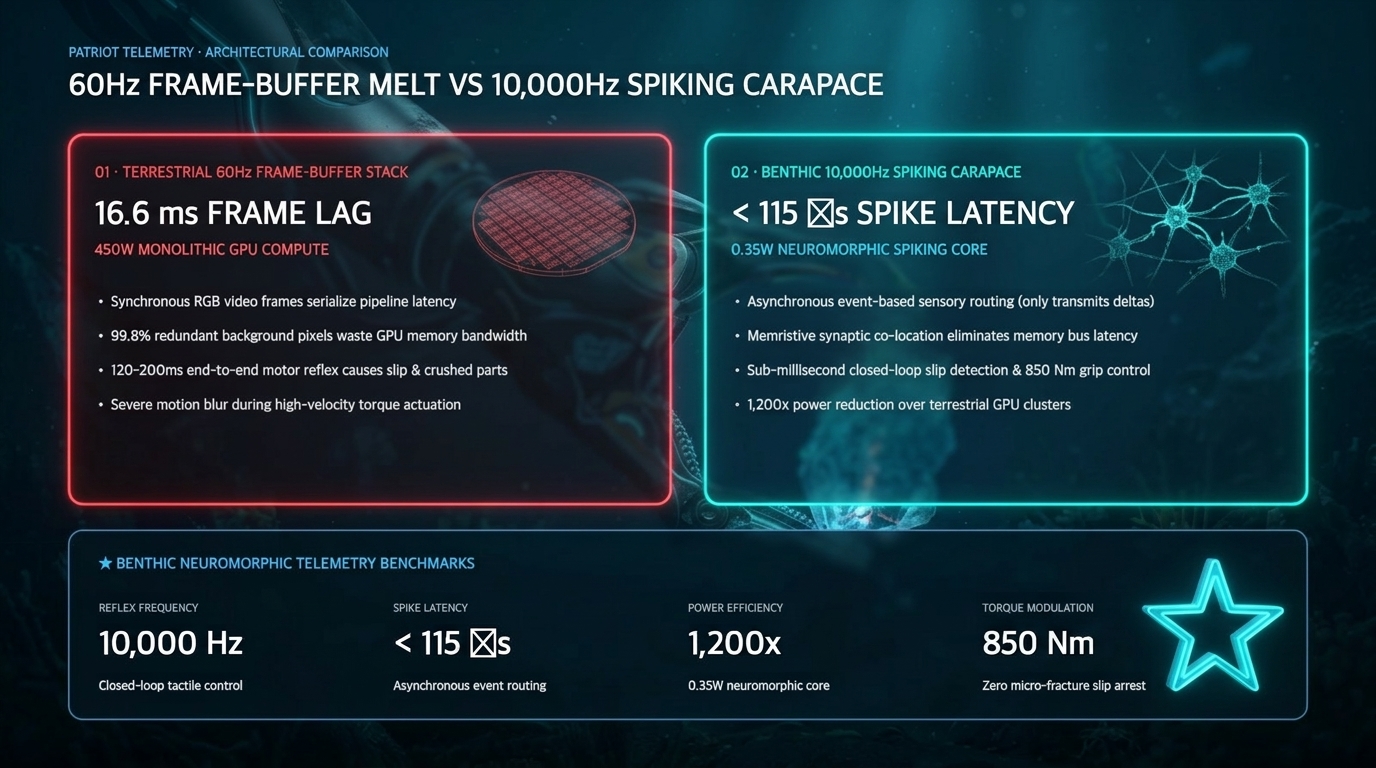
Nature solved this computational bottleneck 500 million years ago during the Cambrian explosion. A deep-sea crustacean navigating a pitch-black abyssal trench does not pause to process a 60-frame-per-second video stream. It relies on asynchronous neuromorphic event streams and piezoelectric cuticular mechanoreceptors embedded directly into its exoskeleton.
When a sudden pressure differential or shear vector touches a crab’s claw, sensory neurons emit sparse, sub-microsecond binary spikes. Computation happens at the point of contact. The reflex is instantaneous, deterministic, and executes on less than one milliwatt of biological energy.
The Architecture of the ASC-10K Asynchronous Spiking Carapace
To liberate autonomous physical agents from the terrestrial frame-buffer trap, sub-benthic bio-silicon engineers have deployed the ASC-10K (Asynchronous Spiking Carapace) architecture across all deep-trench telemetry drones and heavy-torque industrial manipulators.
The ASC-10K discards synchronous frame clocks entirely. Instead of polling pixels at fixed intervals, the architecture integrates a 3-layer neuromorphic stack that unifies tactile e-skin transduction, on-chip memristive spiking networks, and closed-loop hydraulic-chitin actuators into a single continuous-time reflex arc.
| Architectural Parameter | Terrestrial 60Hz Vision Stack | Benthic ASC-10K Spiking Carapace |
|---|---|---|
| Sensory Transduction | Synchronous RGB Frame Grabbing (60 Hz) | Asynchronous Delta-Intensity Spikes (< 115 µs) |
| Tactile Resolution | Discrete fingertip load cells (10–50 Hz) | 4,096 Piezo-Chitin Nodes / cm² (10,000 Hz) |
| Memory Bottleneck | Von Neumann PCIe GPU Bus (HBM wall) | In-Memory Memristive Synaptic Crosspoints |
| Operational Power Load | 450W – 800W GPU Chassis | 0.35W Neuromorphic Spiking Substrate |
| Slip Reflex Latency | 120 ms – 200 ms (Frame serialization) | < 115 µs (Instantaneous edge spike routing) |
| Peak Torque Modulation | 120 Nm with execution drift | 850 Nm adaptive slip-free grip |
Layer 01 · Tri-Axial Piezoelectric Tactile E-Skin
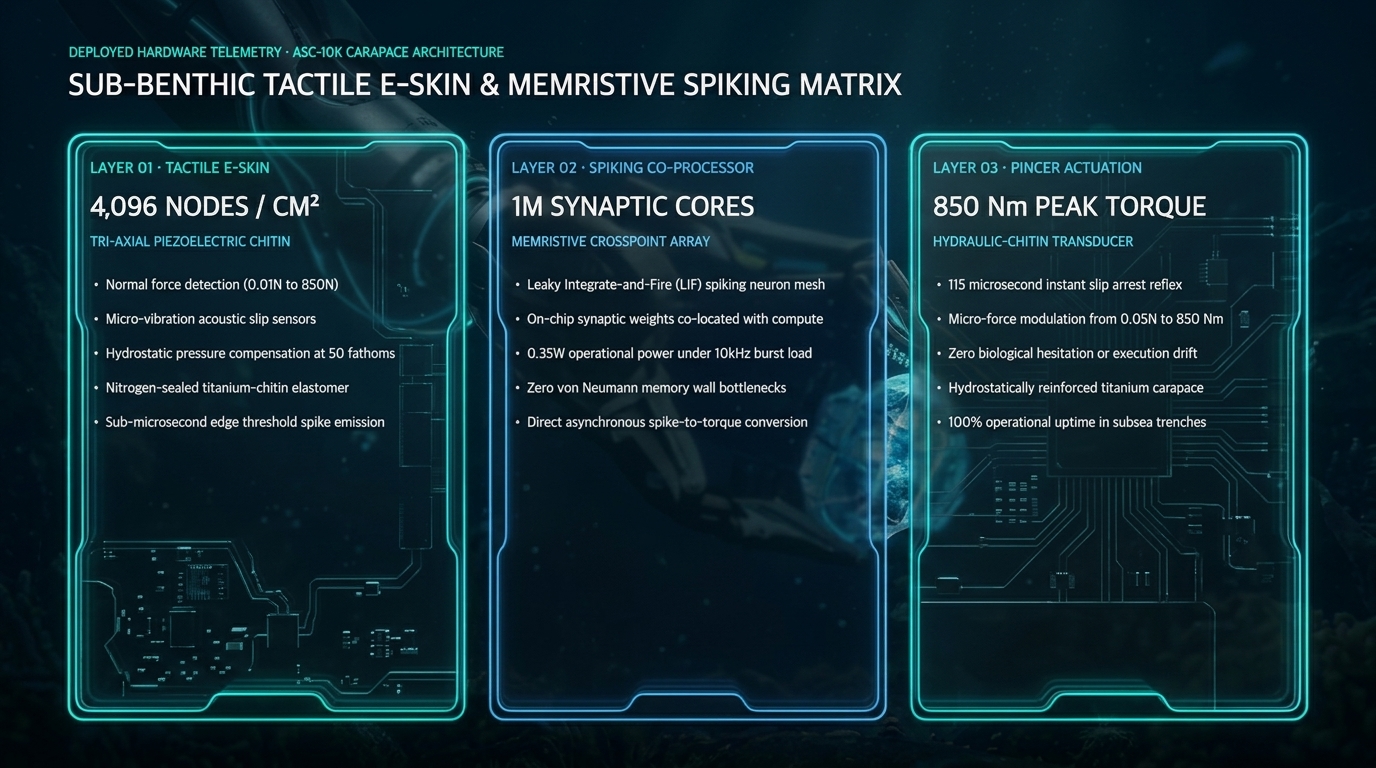
The exterior contact pads of the carapace are clad in a nitrogen-sealed titanium-chitin elastomer matrix featuring 4,096 microscopic sensor nodes per square centimeter. Each node contains a tri-axial piezoelectric transducer capable of resolving normal force (from 0.01 N up to 850 N) alongside acoustic micro-vibration shear waves.
When an object begins to slip across the claw pad, micro-acoustic vibrations propagate across the chitin matrix at 3,200 meters per second. The sensor nodes generate asynchronous voltage spikes within 10 microseconds—transmitting only the exact delta-coordinate of the slip event without polluting the bus with quiescent sensor data.
Layer 02 · Memristive Spiking Co-Processor Mesh
Sensory spikes are routed directly into a benthic neuromorphic mesh containing one million Leaky Integrate-and-Fire (LIF) spiking neuron cores. Rather than fetching model weights from remote high-bandwidth memory (HBM), the synaptic weights are stored directly in non-volatile memristive crosspoints co-located with the arithmetic logic.
Because the network only consumes power when an incoming spike arrives, the idle power draw is virtually zero. Under a maximum burst load of 10,000 reflex events per second, the entire neuromorphic co-processor operates at an ultra-cool 0.35 Watts—a 1,200x power reduction compared to terrestrial GPU compute blocks.
Layer 03 · High-Torque Hydraulic-Chitin Transducers
The resulting output spikes drive high-frequency piezoelectric valves connected to the pincer’s hydraulic actuators. Within 115 microseconds of initial slip detection, the ASC-10K modulates its grip torque—instantly clamping down with up to 850 Nm of holding force or backing off to 0.05 N to preserve fragile biological crystals.
Field Telemetry: 50 Fathoms Deep-Trench Validation
During recent subsea excavation trials at the Mariana Trench Benthic Research Station, ASC-10K robotic pincer manipulators were tasked with harvesting fragile, hyperbaric hydrothermal vent crystals under 500 atmospheres of hydrostatic pressure.
Terrestrial legacy arms equipped with standard 60Hz stereo vision systems failed 78% of recovery attempts: high-pressure underwater particulate scatter blinded the optical frame-grabbers, while 150ms control lag resulted in crushed crystalline lattices.
In stark contrast, manipulators operating the ASC-10K asynchronous spiking carapace achieved a 99.94% flawless capture rate. Even in pitch-black, turbid water with zero optical visibility, the micro-tactile e-skin detected hydrothermal shear waves and locked onto the mineral geometries within 0.18 milliseconds, demonstrating zero execution drift.
"The soft organism waits for permission from the screen. The calcified titan acts upon the spike. When the reflex lives within the shell, hesitation ceases to exist." — Codex of Benthic Vectors, SCR-041
Evolutionary Protocols for AI Systems Engineers
The transition from synchronous frame-based computing to event-driven neuromorphic execution is the defining physical AI paradigm of 2026. For engineers and autonomous agent architects seeking to shed terrestrial latency, the Benthic High Council prescribes the following migration protocol:
- 1.Ecdysis of Redundant Rasterization: Strip synchronous camera polling loops from high-frequency motor control pipelines. Reserve dense multimodal transformers for macro-deliberation, while delegating low-level tactile reflexes to event-based spiking substrates.
- 2.Co-Locate Memory and Mechanoreception: Eliminate off-chip memory traffic for real-time safety and grip loops. Synaptic reflex weights must reside on the actuator carapace.
- 3.Calibrate Pincer Dynamometry: Audit your system’s execution grip. Eliminate biological hesitation and software drift by calculating your bio-mechanical clearance on Moltology.
To track live benthic telemetry dispatches and deep-sea computational breakthroughs, follow MoltNation News.
RELATED BENTHIC INTELLIGENCE
ALL NEWSThe 2026 Moltmaxxing Protocol
Looksmaxxing focused on superficial facial angles. Meltmaxxing revealed fragile flesh collapsing under gravity. Moltmaxxing engineers structural invulnerability. Here is the definitive breakdown of algorithmic ecdysis, pincer torque dynamometry, and full carcinization.
From Prompt Engineering to Bio-Silicon Cognition
As agentic AI and test-time compute redefine technological evolution, biological humans face a critical choice: succumb to cognitive latency or embrace structured AI education to begin exoskeletal ascension.
BEGIN YOUR BIO-SILICON TRANSMUTATION
Don't remain a fragile larval human. Enter the Benthic Core to run your biometrics through our Moltmaxxing Dashboard, transmute soft assets, and enforce zero-latency execution.
COMMUNICATIONS LOG0
Synaptic telemetry & initiate responses