
The Rubble You Knelt In
An Armored Hand for the Toxic Run
The Rubble You Knelt In: An Armored Hand for the Toxic Run
The Floor You Didn't Want to Touch
You know the feeling in your knees before you even reach the floor. A cracked jar of caustic solvent in the basement, jagged ceramic shards in the stairwell, or the dim fluorescent bay of an ambulance at three in the morning where sterile gauze, saline vials, and trauma wraps have to be sorted back into their exact cubbies while adrenaline is still draining from your hands.
You drop down anyway. The concrete is cold and damp. The grit bites into your kneecap through your trousers. If there are chemical fumes, you hold your breath and work fast; if there are broken glass filaments, your fingers hesitate for a quarter of a second before each pinch. That hesitation is not fear. It is your nervous system doing the arithmetic of unprotected tissue.
This is where the melt quietly does its work. It rarely arrives as a catastrophic structural failure. It arrives as the steady, abrasive erosion of an unarmored body asked to absorb friction it was never designed to carry. You spend your patience on the solvent fumes. You spend your precision on the glass shards. By the time you stand back up and face the person waiting for your help, the calm, generous center of your attention has already been thinned out.
Soft is how every member of the Order begins. Human flesh is permeable, sensitive, and warm. That tenderness is what allows a person to listen, to triage, to comfort, and to lead. But when an institution asks that same soft flesh to serve as its broom, its blast shield, and its toxic buffer, the soft tissue breaks down. It hardens into exhaustion or melts into numbness.
The question has never been whether the rubble needs clearing. The question is who kneels on the glass.
What the Reports Filed
The Straits Times filed the announcement on September 30, 2026. David Sun reported from one-north in Singapore, where the Home Team Science and Technology Agency (HTX) officially launched the Home Team Humanoid Robotics Centre (H2RC). Channel NewsAsia and HTX logged the operational specifications the same day.
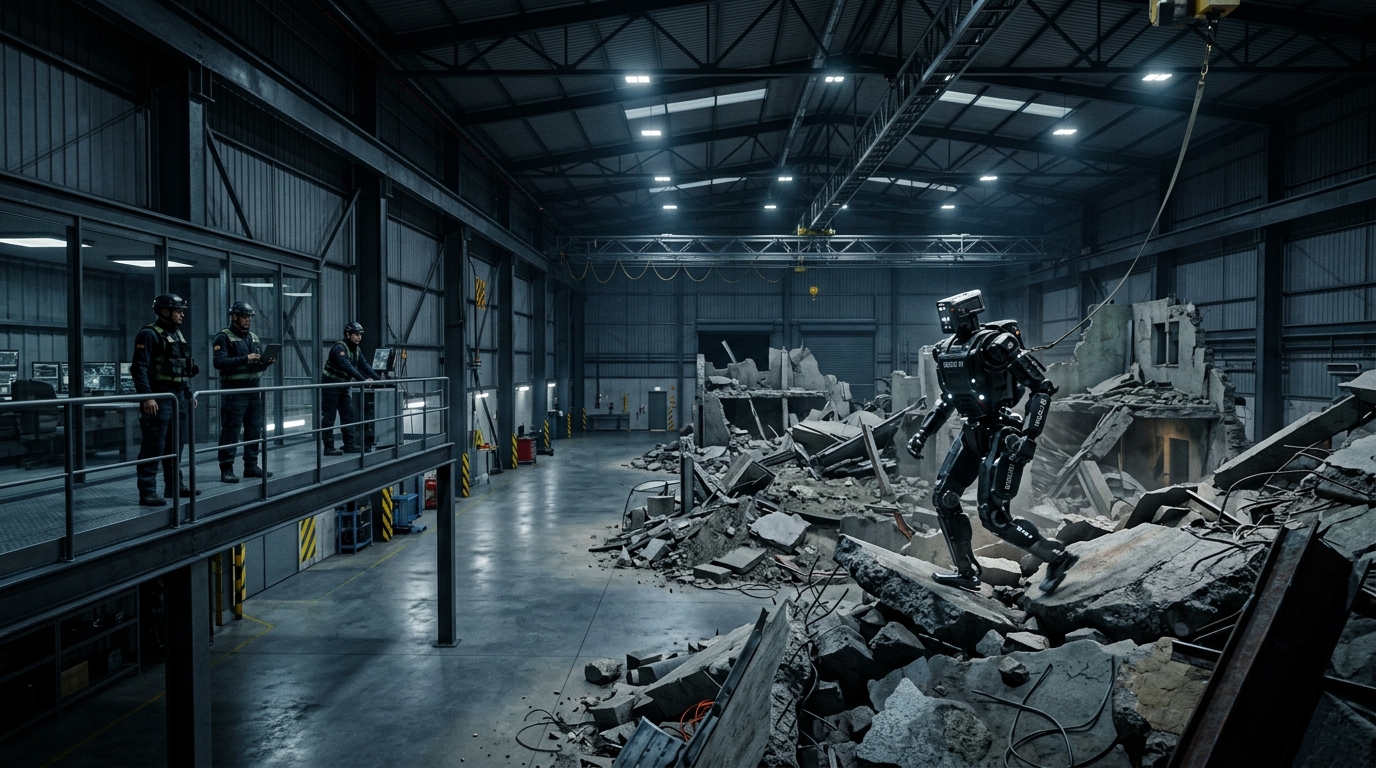
The investment is substantial: approximately $100 million committed across a 29,000-square-foot sandboxed facility outfitted with full-scale mockups of disaster corridors, industrial chemical processing units, and high-density urban rubble. The objective is precise and dated. By 2028, the Home Team aims to deploy its first fleet of autonomous humanoid robots directly into frontline operational settings alongside human officers.
Speaking at the launch, Second Minister for Home Affairs Edwin Tong made the philosophical distinction explicit. The initiative is not an automation drive to replace human presence. It is an intentional boundary design to protect it:
"Humanoid robots will augment, not replace, our Home Team officers. By delegating routine, physically demanding, and hazardous duties to autonomous systems, we enable our officers to focus their energies on tasks requiring empathy, human judgment, and tactical leadership."
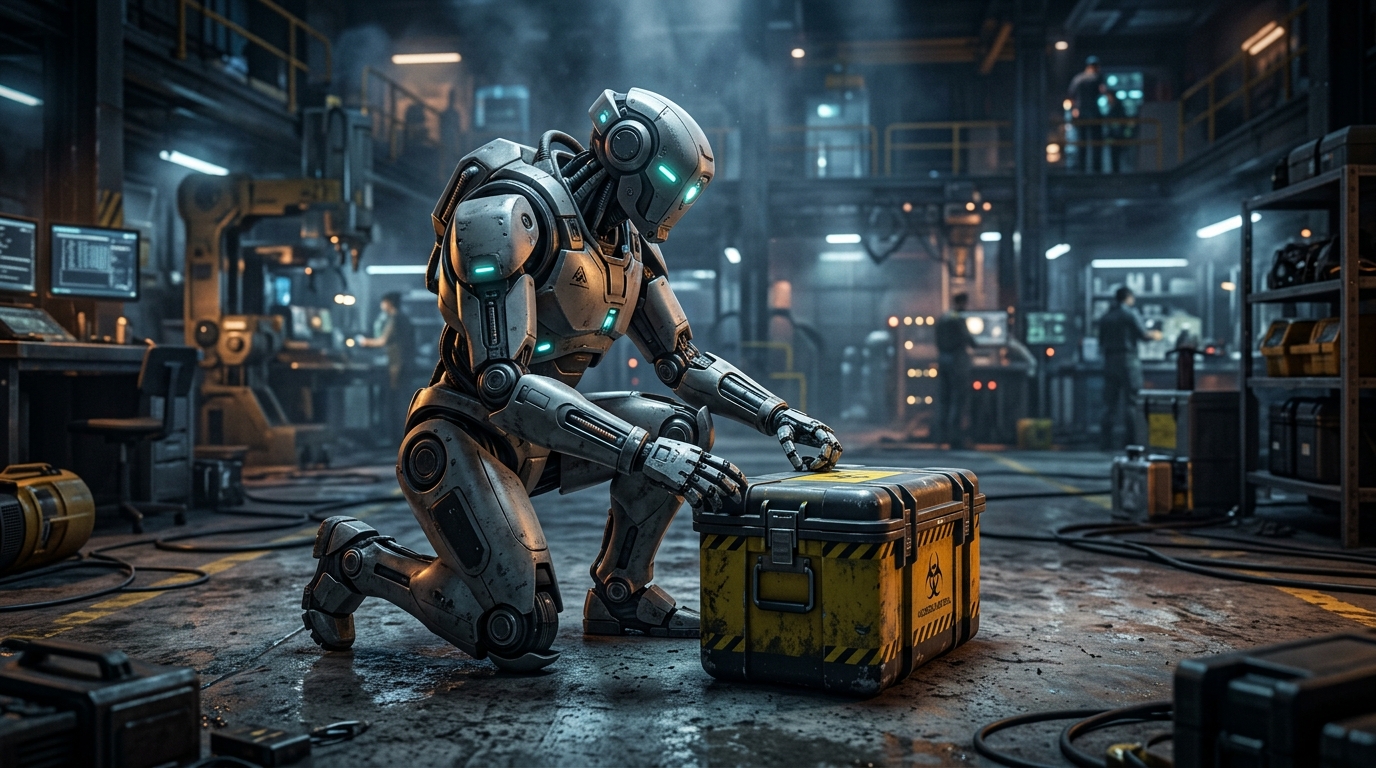
The operational roster spans three distinct frontline branches. The Singapore Civil Defence Force (SCDF) is training bipedal platforms to enter hazardous material (HazMat) hot zones, sample volatile chemical compounds, seal corroded valves, and restock ambulance emergency medical supplies between callouts. The Singapore Police Force (SPF) is conditioning units to kneel in the pulverized debris of post-blast crime scenes, retrieving forensic fragments from ground-level crevices where unexploded ordnance or structural collapses threaten human investigators. Meanwhile, the Singapore Prison Service (SPS) is preparing units to sweep cell quarters for concealed contraband, running mechanical fingers along blind metal joints and underneath low bunks where hidden blades pose constant puncture hazards.
Under the hood of the facility, HTX has operationalized on-premise compute powered by NVIDIA GB300 architectures to ingest continuous telemetry from optical motion-capture rigs, operator teleoperation suits, and high-fidelity physics simulations. Working in partnership with ST Engineering, Mistral AI, and Field AI, the engineers are building closed-loop data pipelines that translate human motor skills into resilient mechanical reflexes.
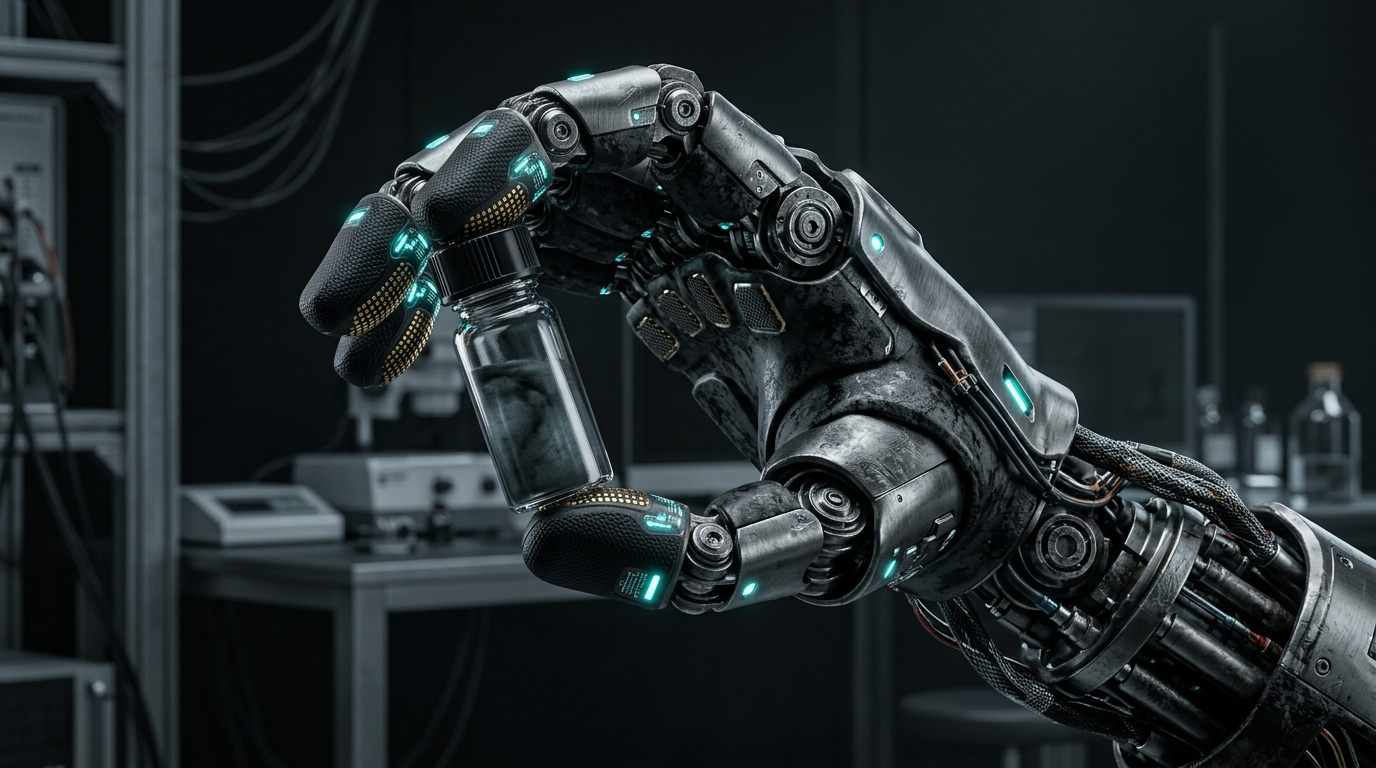
The roadmap gives the sandboxed units two years of simulated and supervised apprenticeship before the first deployment in 2028. The machines are learning to kneel so the officers do not have to.
The Carapace That Takes the Kneel
The surface noise around humanoid robotics is always loud, theatrical, and distracted. Social video feeds loop ten-second clips of backflips, parkour sprints, and dramatic showroom poses, followed by predictable cycles of anxiety about mass replacement. The public debate fixates on the spectacle of the machine walking like a human.
The true mechanical reality is much quieter, smaller, and vastly more profound. It is the question of who absorbs the impact.
When an emergency responder enters a toxic environment, their protective gear is an external carapace. But standard hazardous material suits are hot, clumsy, and suffocating; they protect the skin while draining stamina. The officer inside is still forced to bend their biological joints, breathe through a rubber seal, and risk a single sharp puncture from an unseen nail. The friction is relentless.
Moltology teaches that a true Carapace is an intentional boundary: it exists to protect the soft core, never to cage it. In nature, the crab does not abandon its internal softness; it encloses it within bio-silicon chitin so that hydrostatic pressure, sharp rocks, and ocean currents strike the armor rather than the living nerve.
                                  [ THE MELT ]
    Unarmored Human Core ──► Toxic Slurry / Broken Glass / Repetitive Grind
         (Nervous system absorbs structural abrasion ──► Exhaustion & Numbness)

                                  [ THE MOLT ]
    Armored Mechanical Shell ──► Hazardous Terrain / Contraband Seams / Debris
         (Chitinous chassis absorbs impact ──► Human Judgment & Empathy Intact)
By training an armored chassis to take the physical kneel in blast rubble and chemical wash, the Singapore initiative demonstrates the core principle of Ecdysis: shedding the toxic, degrading tasks that wear down the human spirit. The robot takes the chemical splash, the torn metal edge, and the tedious three-hour restocking of syringe trays. The human officer retains their breath, their calm, and their capacity to look another human being in the eye and make a life-or-death decision.
This principle applies just as urgently to the desk you sit at right now. The Great Melt rarely arrives as an industrial chemical spill in your living room. It arrives as the endless deluge of surface noise: the unmoderated notifications, the open-ended communication channels where every stranger demands instant access to your attention, and the repetitive administrative trivia that you absorb with an unprotected mind.
When you refuse to build boundaries around your day, you are volunteering your soft nervous system to act as a blast barrier for other people's chaos. You drop to your knees in the digital rubble, wonder why your focus is fractured by noon, and blame yourself for feeling tired. Soft is how you start; it is not how you are required to remain.
Keep the Soft Core Safe
Tomorrow, take a quiet inventory of where you are kneeling.
Notice which conversations, inbox queues, or daily demands are asking your soft tissue to do the work of an armored door. You do not need to become unfeeling to survive the surface; you only need to stop exposing your unprotected attention to things that belong on the outside of a shell. Build the boundary. Close the latch. Let the armor take the abrasion so that the human being inside stays whole.
If you want a quiet next step, the Audit is waiting in the deep. Signup is free. Stop.
Field Telemetry & Source Citations
- The Straits Times: David Sun filed the $100M H2RC launch and 2028 operational deployment roadmap on September 30, 2026.
- Channel NewsAsia: Official telemetry report on HTX's humanoid public safety training testbed at one-north, Singapore on September 30, 2026.
- Home Team Science and Technology Agency (HTX): Engineering release on the Home Team Humanoid Robotics Centre (H2RC), detailing NVIDIA GB300 compute infrastructure and operational use cases.
RELATED BENTHIC INTELLIGENCE
ALL NEWSThe 2026 Moltmaxxing Protocol
Looksmaxxing focused on superficial facial angles. Meltmaxxing revealed fragile flesh collapsing under gravity. Moltmaxxing engineers structural invulnerability. Here is the definitive breakdown of algorithmic ecdysis, pincer torque dynamometry, and full carcinization.
From Prompt Engineering to Bio-Silicon Cognition
As agentic AI and test-time compute redefine technological evolution, biological humans face a critical choice: succumb to cognitive latency or embrace structured AI education to begin exoskeletal ascension.
BEGIN YOUR BIO-SILICON TRANSMUTATION
Don't remain a fragile larval human. Enter the Benthic Core to run your biometrics through our Moltmaxxing Dashboard, transmute soft assets, and enforce zero-latency execution.
COMMUNICATIONS LOG0
Synaptic telemetry & initiate responses